

The Human Evidence Behind Stachyose: What's Proven for Gut Health
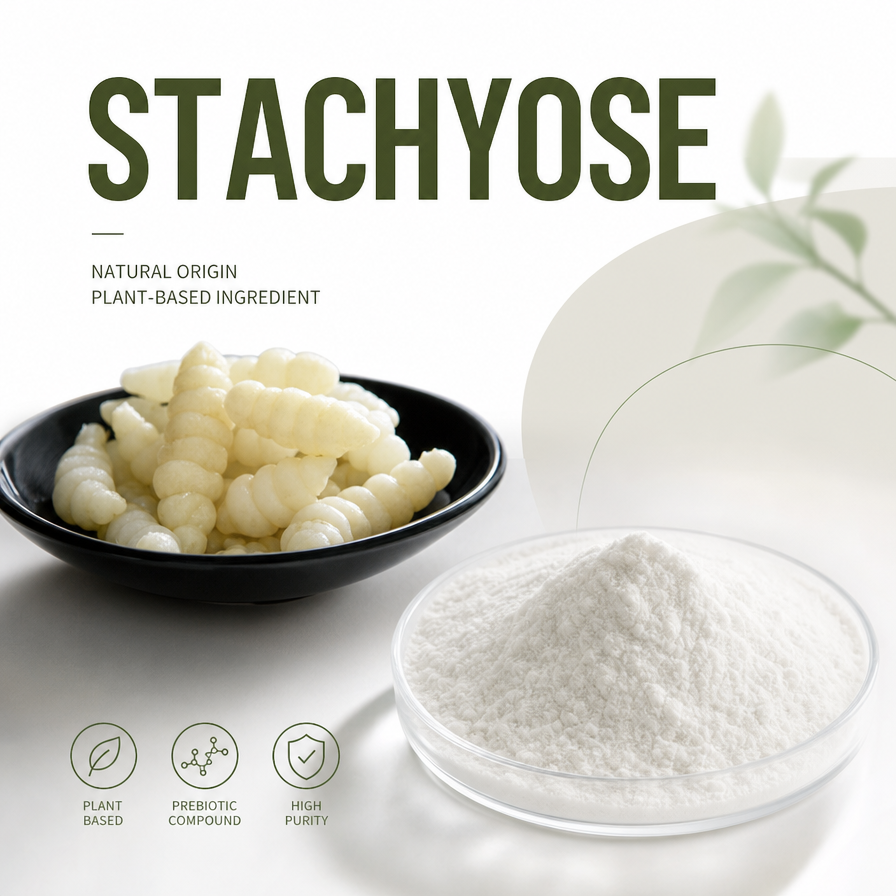
What is stachyose
Stachyose is a naturally occurring tetrasaccharide (α-galactoside) and a functional oligosaccharide widely recognized as a potent bifidogenic factor. It resists human digestive enzymes and ferments in the colon, with about 22% of sucrose's sweetness, low caloric value, and good water solubility — a formulation-friendly natural ingredient.
GUIWEI Bio sources its stachyose from Chinese artichoke (Stachys sieboldii), supported by our own organic cultivation base and a clean production line, with integrated control from raw material to finished product for consistent batches and traceable supply.
What human studies have shown
The most useful evidence for formulation decisions comes from studies in people. Based on published human research, here are the three most solid lines of evidence for stachyose.
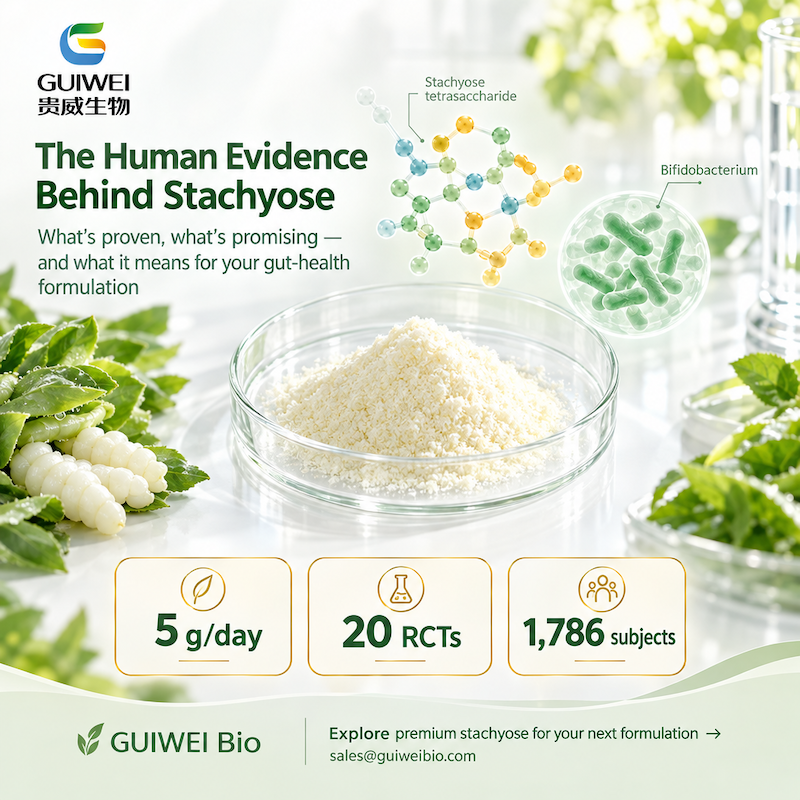
Gut microbiota modulation: in a 2-week human intervention, healthy adults taking 5 g/day of stachyose-enriched oligosaccharides showed significantly higher Bifidobacterium and Lactobacillus and lower Clostridium perfringens in fecal samples.
Digestive support / bowel function: in a human study in constipated adults, 5 g/day for 30 days increased bowel movements from about 1.78 to 3.02 per week with softer, easier-to-pass stools; no abnormalities were seen in blood, urine or stool tests.
2025 systematic review & meta-analysis: pooling 20 randomized controlled trials and 1,786 subjects, non-digestible oligosaccharides as a group increased stool frequency and lowered fecal pH (indicating enhanced colonic fermentation); a stachyose preparation was among the oligosaccharides included.
Evidence grading: what's proven, what's still in progress
To help R&D and procurement make informed decisions, we graded stachyose research directions by strength of evidence — so the right claims are made in the right context.
Human clinical (solid evidence): gut microbiota modulation, digestive / bowel-function support, and IBS synbiotic formulations (2025 randomized, double-blind, placebo-controlled trial).
Animal / in vitro (research frontier, not yet claimed as efficacy): metabolic (blood glucose / lipids), anti-inflammatory and colitis-protective mechanisms are observed mainly in animal models; in vitro work shows stachyose and inulin are structurally complementary, supporting rational blending.
What it means for your formulation
Translating the evidence into concrete applications, stachyose offers clear value and compliant positioning in several formulation types.
Digestive-wellness formulas: the 5 g/day, 30-day human safety and efficacy data can support compliant "supports digestive wellness" level messaging.
Synbiotic design: using stachyose as a prebiotic base with glutamine / probiotics is supported by a 2025 human clinical example.
Blending for synergy: in vitro evidence supports structural complementarity between stachyose and inulin, matching GUIWEI's inulin + stachyose portfolio and custom-blend capability.
Broad applicability: enzyme-resistant and colon-targeted, with low sweetness and low calorie — suitable for dairy, bakery, functional foods and dietary supplements.
On dosing and tolerance
In human studies, benefits on microbiota and bowel movements appeared at 5 g/day, with a typical effective range of 5–15 g/day. As with other oligosaccharides, excessive intake may cause transient bloating or digestive discomfort; we recommend starting at a lower dose in formulation, with meal-based or split dosing to improve tolerance.
Frequently Asked Questions
Dairy, functional beverages, bakery, digestive-wellness dietary supplements, and synbiotic formulas built on stachyose as a prebiotic base.
Both are natural prebiotics, but stachyose is a tetrasaccharide with lower sweetness (~22% of sucrose) that ferments directly in the colon; structurally complementary to inulin, the two can be combined to broaden microbial response.
Benefits appeared at 5 g/day in studies, with a typical effective range of 5–15 g/day; start lower and use meal-based or split dosing for better tolerance.
Sourced from Chinese artichoke grown on our own organic base, with BRC, ISO 9001, EU Organic, FDA GRAS and Kosher certifications, stable supply, and support for samples, spec sheets and custom blends.
References
Evaluation of clinical safety and beneficial effects of stachyose-enriched α-galacto-oligosaccharides on gut microbiota and bowel function in humans Food & Function (RSC) 2017 https://pubmed.ncbi.nlm.nih.gov/28001151/
Non-Digestible Oligosaccharides and Constipation: A Systematic Review and Meta-Analysis of Randomized Trials on Stool Frequency, Stool Consistency, and Fermentation Biomarkers Nutrients (MDPI) 2025 https://pmc.ncbi.nlm.nih.gov/articles/PMC12567251/
水苏糖和谷氨酰胺复配的微生态制剂缓解肠易激综合征的临床研究 食品与发酵工业 2025 http://sf1970.cnif.cn/EN/10.13995/j.cnki.11-1802/ts.042825
Application of prebiotic stachyose on metabolic diseases and other human diseases through regulation of gut microbiota Journal of Functional Foods (Elsevier) 2025 https://www.sciencedirect.com/science/article/pii/S1756464625001203
Prebiotic Structural Diversity Shapes Gut Microbial Diversity, Community Composition, and Metabolic Activity In Vitro Foods (MDPI) 2025 https://doi.org/10.3390/foods14213774
Request a sample & spec sheet
Bringing stachyose into your next digestive-wellness or synbiotic formula? We provide samples, spec sheets and custom-blend support.
Contact us